Internship Progress Week 11 (September 11 ~ September 16)
As the ROS ecosystem migrates to newer distributions and simulation engines, ensuring cross-platform support remains critical for educational tools like JdeRobot’s Robotics Academy.
Historically, running Robotics Academy on macOS (Apple Silicon ARM64) faced performance bottlenecks, architecture emulation overhead via Rosetta 2, and deadlock issues when pairing older Gazebo versions (Classic and Harmonic) with headless virtual displays (xvfb).
In this work, we explored, built, and validated a native ARM64 stack running ROS 2 Jazzy Jalisco and the new Gazebo Jetty within Docker on macOS, using the classic Follow Line exercise as the primary benchmark.
Demonstration Video
Watch the complete demonstration of the F1 car running autonomously in the Gazebo Jetty simulation on macOS:
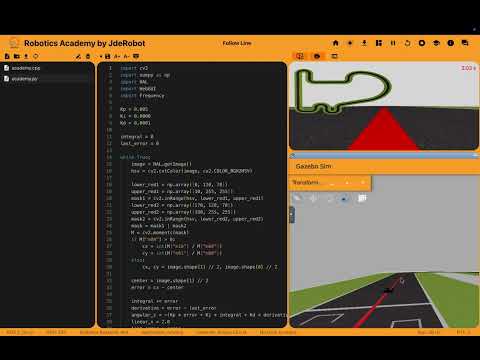
(Click the image above to watch the video on YouTube)
The Challenge
Running modern robotics simulations on Apple Silicon presents three distinct engineering hurdles:
- CPU & Architecture Constraints: Avoiding emulation layers by compiling native ARM64 Docker images.
- GPU Passthrough Limitations: macOS Docker Desktop does not offer direct hardware GPU acceleration (
/dev/dri), requiring highly optimized CPU-based software rasterization. - Ecosystem Upgrades: Accommodating API breaks, namespace shifts, and ABI incompatibilities introduced between ROS 2 Humble/Iron and ROS 2 Jazzy.
Technical Obstacles & Solutions
1. Docker Build Pipeline & Compiler Throttling
Compiling large ROS 2 workspaces on Docker Desktop for Mac often triggers the Linux kernel Out-Of-Memory (OOM) killer on heavy C++ translation units.
- The Fix: We constrained
colcon buildto sequential compilation usingMAKEFLAGS="-j1"and--executor sequential. - API Breakages: We dynamically patched legacy C++ includes (
#include <cv_bridge/cv_bridge.h>to#include <cv_bridge/cv_bridge.hpp>), added thelarkparser dependency required by Jazzy’srosidl_generator_rs, and excluded unmaintained industrial robotics packages incompatible with MoveIt 2’s refactored time parameterization.
2. The NumPy 2.0 vs. cv_bridge ABI Clash
When attempting to retrieve camera frames via HAL.getImage(), the Python process crashed immediately with:
1
ImportError: A module that was compiled using NumPy 1.x cannot be run in NumPy 2.4.6 as it may crash.
ROS 2 Jazzy’s system-installed cv_bridge binaries were built against the NumPy 1.x C-API, while standard pip installations in Python 3.12 pulled NumPy 2.x.
- The Fix: We downgraded and pinned the dependencies to
numpy<2(1.26.4),opencv-python<4.10, andcontourpy<1.2, then committed the layers permanently into thejderobot/robotics-academy:testimage.
3. Resolving Extreme Simulation Lag (Real Time Factor)
We faced two distinct issues that caused the Gazebo Real Time Factor (RTF) to drop to unplayable levels (as low as 0.001 to 0.204):
A. Graphics Rasterizer Limitations:
- The Root Cause: The container originally defaulted to
GALLIUM_DRIVER=softpipe, a single-threaded reference software rasterizer. - The Fix: We configured the environment to use
GALLIUM_DRIVER=llvmpipe. This multi-threaded LLVM JIT rasterizer brought the simulation performance up significantly, allowing rendering to run smoothly on Apple Silicon CPUs.
B. Python CPU Starvation:
- The Root Cause: The user’s autonomous control script ran inside an unthrottled
while True:loop. Because Docker on Mac tightly shares CPU cores, this unconstrained OpenCV processing loop consumed 100% of a core, starving Gazebo’s software renderer and causing the RTF to plummet to 0.2. - The Fix: We implemented a strict loop rate limiter (
Frequency.tick(50)) at the end of the control script. Throttling the logic to 50 iterations per second instantly freed up CPU resources, restoring the simulation RTF to a stable1.0.
4. Topic Remapping for Gazebo Jetty
In the new Gazebo Jetty integration, topics were bridged under the /f1/ entity namespace:
- Camera stream:
/f1/camera/image_raw - Motor commands:
/f1/cmd_vel - Odometry:
/f1/odom
However, the exercise template code (HAL.py and WebGUI.py) still queried legacy topic names (/cam_f1_left/image_raw and /cmd_vel). Because the legacy topic was never published, HAL.getImage() entered an infinite while image is None: loop, freezing code execution before any velocity commands could be sent. Updating HAL.py and WebGUI.py to target the active /f1/ topics resolved the data flow instantly.
5. UI Frame Collision & Flicker Elimination
Once video frames started streaming, the web browser UI began rapidly alternating between the raw RGB camera feed and the binary threshold mask.
- The Root Cause: A background worker thread in
WebGUI.pywas streaming raw camera frames at 30 FPS, directly competing with the student script’s explicit calls toWebGUI.showImage(debug). - The Fix: We disabled the background auto-streaming thread in
WebGUI.py, giving the user’s perception script complete authority over the displayed frame, cleanly showing either the RGB road or the threshold mask based on the script’s output.
The Autonomous Control Implementation
With the simulation and perception pipeline stabilized, the F1 vehicle autonomous controller operates as follows:
- Perception: Frames are captured from
/f1/camera/image_raw, converted from BGR to HSV color space, and segmented using dual-range red thresholding to isolate the central track line. - Centroid Tracking: Spatial moments (
cv2.moments) calculate the horizontal center of mass (cx) of the detected line. - PID Steering: The horizontal error between the image midpoint and the centroid feeds into a PID controller to compute the target angular velocity: \(\text{angular\_z} = -(K_p \cdot \text{error} + K_i \cdot \int \text{error} + K_d \cdot \frac{d\,\text{error}}{dt})\)
- Actuation: Linear and angular velocities are published directly to
/f1/cmd_vel, keeping the car aligned on the track throughout turns and straightaways.
Conclusion & Future Scope
This milestone confirms that ROS 2 Jazzy and Gazebo Jetty can run natively, stably, and interactively on macOS Apple Silicon via Docker without relying on emulation layers.
Next steps include:
- Benchmarking sustained RTF across more complex multi-robot and drone environments in the Academy.
- Packaging the updated configuration and Docker recipes into an upstream pull request for JdeRobot.