Internship Progress Week 15 (October 08 ~ October 14)
Nav2 Solution Upstream PR, Follow Line RTF Optimization, and Monaco Circuit Investigation
This report covers the progress made during Week 15 (October 08 ~ October 14, 2026). Following the validation of exercises on the new jderobot/robotics-academy:lyrical-beta Docker image, our work this week focused on three main objectives:
- Submitting the upstream Nav2 Amazon Warehouse solution to
JdeRobot/RoboticsAcademy-solutionsfor testing by other developers and mentors. - Diagnosing and resolving the Real-Time Factor (RTF) fluctuations on the Follow Line exercise, bringing simulation performance to a steady ~1.0 on CPU runtime.
- Investigating and implementing fixes for the Monaco Circuit performance bottleneck (Issue #3493 / RoboticsInfrastructure #632).
1. Video Demonstration
Real-Time Factor (RTF) Stabilization on RADI lyrical-beta (Follow Line)
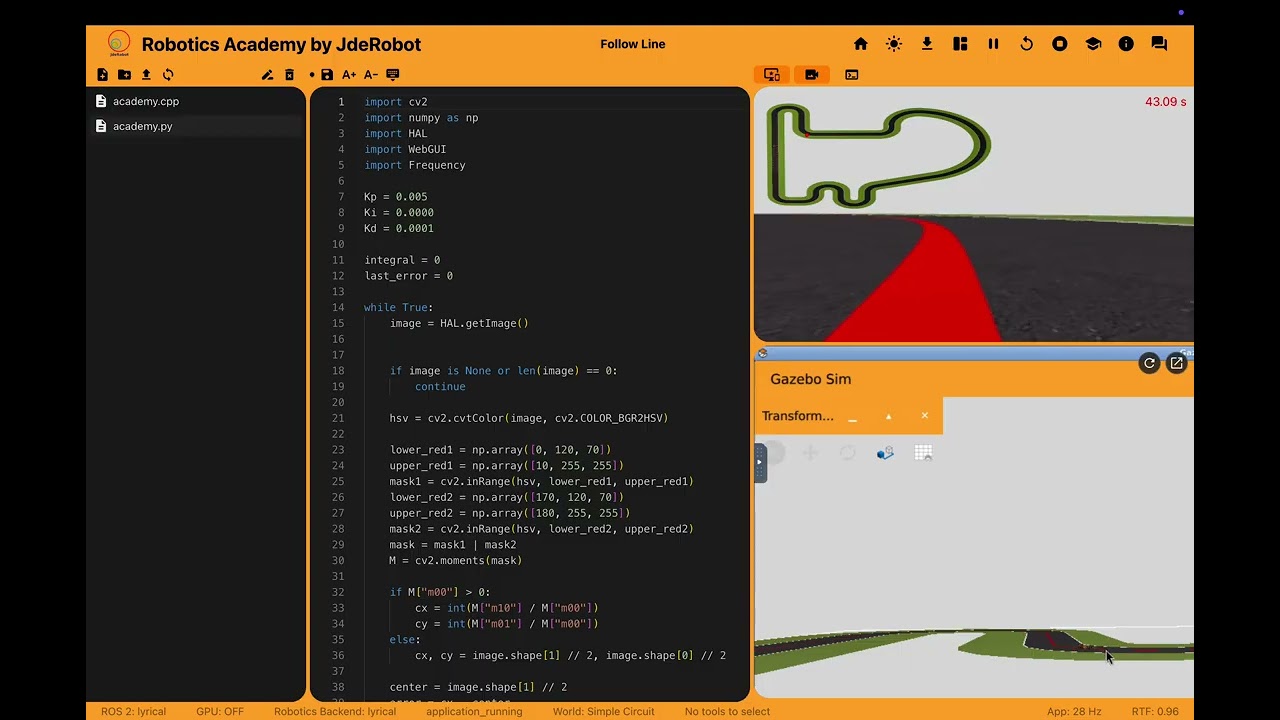
Direct YouTube Link: https://youtu.be/xj7M6wV-nEg
2. Upstreaming the Amazon Warehouse Nav2 Solution
Following mentor recommendations to provide our Nav2 implementation to other developers for cross-platform testing, we prepared and submitted our contribution:
- Issue Raised: Opened a tracking issue on RoboticsAcademy-solutions outlining the architecture of the native ROS 2 Nav2 warehouse solution.
- Pull Request Submitted: Submitted a clean, documented PR containing:
- Asynchronous
NavigateToPoseaction client integration. - Waypoint coordination for rack pick and drop cycles.
- Platform motorized lift control interfacing with warehouse pallet geometry.
- Usage documentation for reproducing the run across different environments.
- Asynchronous
3. Diagnosing and Fixing the RTF Fluctuation on Follow Line
During initial runs of the Follow Line exercise on CPU-only macOS/Rosetta environments, the Real-Time Factor (RTF) was fluctuating heavily between 0.1 and 1.1. Profiling revealed three primary CPU bottlenecks:
- Camera Sensor Overheads (
f1_gz.urdf.xacro):- The camera was rendering at 640x480 resolution with a per-pixel Gaussian noise filter and
<visualize>true</visualize>. - On CPU software rendering (software OpenGL / llvmpipe), calculating Gaussian noise across every pixel at 20 Hz saturated CPU cores.
- Fix: Reduced resolution to 320x240, removed the CPU noise filter plugin, and disabled visualization.
- The camera was rendering at 640x480 resolution with a per-pixel Gaussian noise filter and
- World Physics & Rendering Configuration (
simple_circuit.world):- Simulation step sizes were previously unbounded, resulting in variable iteration workloads.
- Dynamic shadows (
<shadows>true</shadows>,<cast_shadows>true</cast_shadows>) incurred heavy software rasterization costs. - Fix: Configured an explicit 4ms physics time step (
<max_step_size>0.004</max_step_size>, target RTF 1.0), disabled dynamic shadows, and cappedSceneBroadcasterpublication to 25 Hz.
- CPU Busy-Wait in Python Templates:
- In
HAL.py,getImage()executed a tightwhile image is None:loop without yielding execution, consuming 100% of an entire CPU core. - Fix: Added
time.sleep(0.005)inside the wait loop and corrected loop timing logic inFrequency.py.
- In
Outcome: These optimizations eliminated the CPU spikes entirely, achieving a stable RTF of ~0.96 - 0.98 (~1.00) as shown in the video demonstration.
4. Monaco Circuit Investigation & Ongoing Work (Issue #3493)
We investigated the Monaco Circuit performance degradation where RTF crashed down to 0.1 - 0.2 on 3D slopes and elevation changes:
- Root Cause Analysis:
- On flat tracks (Simple Circuit), mesh collision is trivial (mesh-vs-plane).
- In Monaco,
monaco_track.daecontains ~18,700 triangles across complex 3D hills and cambers. - The F1 car model was using the high-polygon visual mesh (
Car.objwith ~36,000 triangles) directly for its<collision>geometry. - On elevation changes, DART physics was forced to calculate thousands of triangle-triangle contact manifolds every timestep, causing the solver to stall.
- Fixes Implemented:
- Collision Primitives: Replaced the heavy
Car.objmesh collision inf1_common.urdf.xacrowith lightweight geometric primitives (1 box for chassis, 4 spheres for wheels). - Contact Softening: Configured surface contact parameters in
model.sdfto eliminate edge chatter. - Spawn Coordinates: Corrected the initial vehicle pose in
world_dband world files from off-track water coordinates(-105.2, -70.7)to the start line(-0.5, 10.85, 0.35). - Camera Tracking: Updated
default.configto bind Gazebo GUI tracking directly to thef1vehicle.
- Collision Primitives: Replaced the heavy
- Ongoing Work:
- Tuning PID lateral tracking and dynamic speed profiles to handle tight elevation changes and sharp corners (Sainte-Devote) reliably without track departure.
5. Summary & Next Steps
- Raised issue and submitted PR for the Amazon Warehouse Nav2 solution to
RoboticsAcademy-solutions. - Fixed the RTF fluctuation bottleneck on Follow Line, stabilizing execution at ~1.0 RTF on CPU runtime.
- Completed root-cause diagnosis and collision optimization for the Monaco Circuit; currently refining controller parameters for elevated track sections.