Internship Progress Weeks 13 & 14 (September 24 ~ October 07)
Validating Exercises on the New RADI lyrical-beta Image and Implementing Full Nav2 Amazon Warehouse Automation
This combined report covers the progress made across Weeks 13 and 14. Following guidance and recommendations from lead mentor José María Plaza (@jmplaza), we transitioned our development and validation workflow to JdeRobot’s new in-development Docker image: RADI lyrical-beta (jderobot/robotics-academy:lyrical-beta).
This next-generation image brings native ROS 2 Lyrical integration together with the modernized Gazebo Harmonic (gz-sim) simulation engine and an updated Robotics Application Manager (RAM) toolchain. Working directly on this development-stage image allowed us to test upcoming platform features, resolve low-level runtime integration issues, and successfully build and validate two core exercises: Autonomous Line Following and the Amazon Warehouse logistics pipeline.
1. Video Demonstrations & Previews
A. Autonomous Line Following (Vision & PID on RADI lyrical-beta)
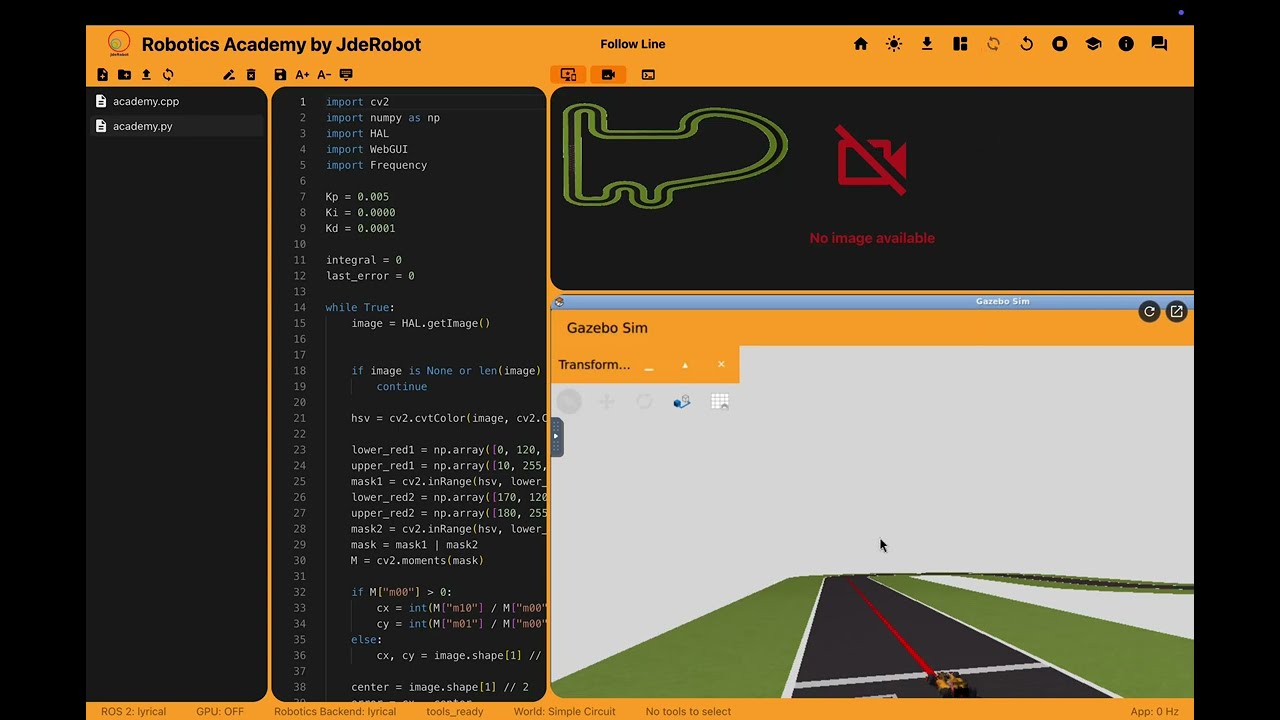
Direct YouTube Link: https://youtu.be/BsxOF49f_bM
B. Amazon Warehouse Logistics (ROS 2 Nav2 on RADI lyrical-beta)
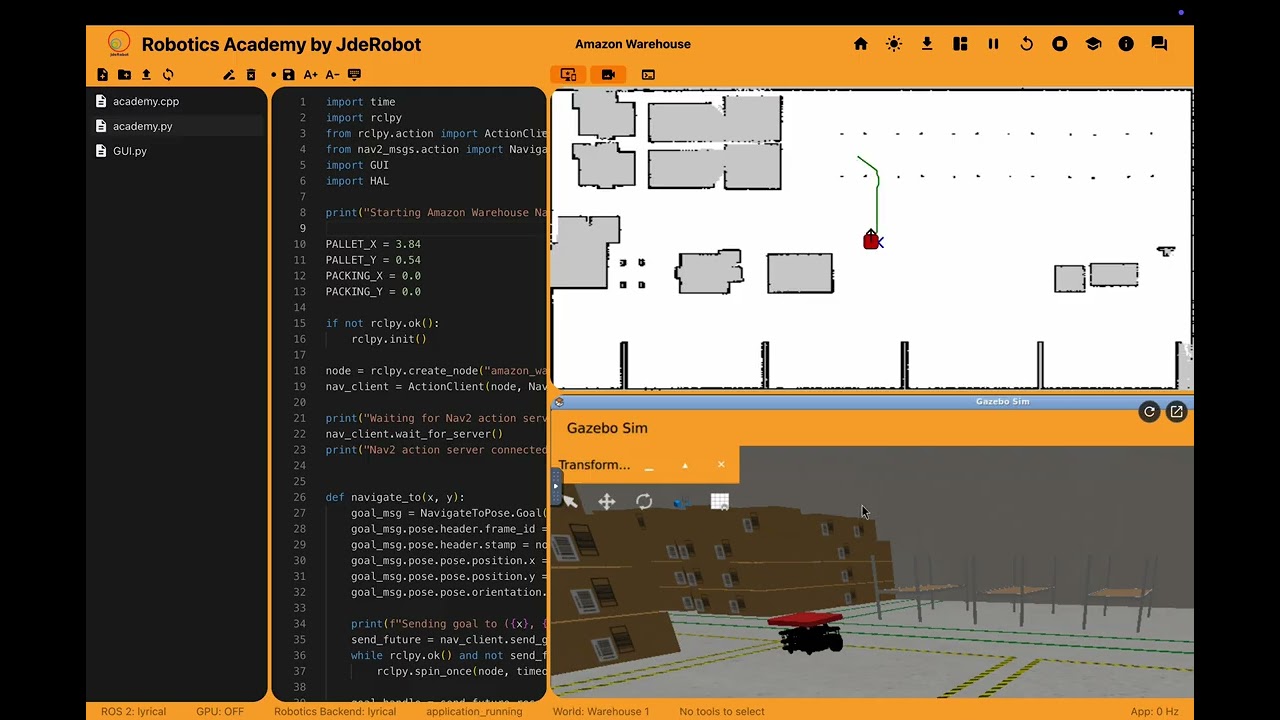
Direct YouTube Link: https://youtu.be/2nGsmhxEtA0
2. Migration to the New RADI lyrical-beta Image
Following guidance from José María Plaza (@jmplaza), we migrated our environment away from older base containers to focus on the jderobot/robotics-academy:lyrical-beta build.
Key architectural improvements in the new image:
- Modern Simulation Stack: Native Gazebo Harmonic (
gz-sim) replacing older simulation binaries. - Updated Middleware: Direct ROS 2 communication nodes without legacy ROS 1 / ROS 2 bridge bottlenecks.
- Modern Web Application Architecture: Integrated RAM WebSocket server and React-based frontend telemetry.
Because the image is actively in development, getting our workflow properly configured required resolving containerized Python virtual environment (/.venv) path configurations, workspace sourcing scripts, and TurboVNC / noVNC headless rendering pipelines on macOS Apple Silicon.
3. Autonomous Line Following on RADI lyrical-beta
Using the new RADI environment, we ported and validated the visual servoing control loop for the Formula 1 racing car:
- Perception Pipeline:
- Captured front-facing monocular camera frames via ROS 2 image transports.
- Converted color representations from BGR to HSV for reliable segmentation of the guidance line under variable lighting.
- Applied morphological opening and closing to suppress ground noise.
- Calculated spatial image moments ($M_{00}$, $M_{10}$, $M_{01}$) to determine the line centroid: \(c_x = \frac{M_{10}}{M_{00}}\)
- Control Loop & Dynamic Velocity Profiling:
- Evaluated lateral tracking error: $e_t = \text{image_center}_x - c_x$.
- Implemented a discrete PID controller generating smooth steering commands ($\omega_z$).
- Implemented dynamic velocity regulation that scales linear throttle inversely with steering curvature, preventing track departure on hairpin turns.
4. Amazon Warehouse with Full ROS 2 Nav2 Autonomy
Building upon our initial exploration from Week 12, we completed the full autonomous logistics pipeline for the Amazon Warehouse using the ROS 2 Nav2 architecture on the new lyrical-beta image.
Technical Architecture & Workflow
- Nav2 NavigateToPose Action Client: Implemented a dedicated ROS 2 Action Client communicating with the Nav2 server to dispatch goals asynchronously.
- Global A* Path Planning: The navigation server ingests the 2D warehouse occupancy grid, applies obstacle inflation for shelf buffers, and computes optimal collision-free routes.
- Automated Pallet Handling Sequence:
- Phase 1 (Dispatch): Robot navigates to the target pallet rack at
(X: 3.84, Y: 0.54). - Phase 2 (Pick): Robot centers beneath the pod bay and commands the motorized vertical platform lift (
/logistic_robot/platform/cmd_vel) to raise the rack. - Phase 3 (Transit): Nav2 plans a collision-free return route to the fulfillment area at
(X: 0.0, Y: 0.0). - Phase 4 (Drop): Lowers the platform and confirms task completion.
- Phase 1 (Dispatch): Robot navigates to the target pallet rack at
5. Debugging & Infrastructure Fixes on the New Development Stack
While validating the exercises on the new lyrical-beta build, we identified and resolved critical interface bugs:
- WebGUI WebSocket Async/Sync Interface Crash:
- Bug: In
measuring_threading_gui_harmonic.py, the GUI sender thread executedawait self.update_gui(). InWebGUI.py,update_gui()is a standard synchronous method returningNone. This raisedTypeError: 'NoneType' object can't be awaited, killing the telemetry loop immediately. - Fix: Added inspectable awaiting (
if inspect.isawaitable(res): await res) and madesend_to_client()queue-safe.
- Bug: In
- WebSocket Handshake Deadlock:
- Bug:
MeasuringThreadingGUIinitializedack_frontend = False, stalling telemetry output if the frontend sent thestarthandshake prior to the internal WebSocket connection establishing. - Fix: Initialized
ack_frontend = Trueand introduced a 0.5s timeout fallback so telemetry streams continuously.
- Bug:
- Map Coordinate Orientation & Trajectory Rendering:
- Bug: Nav2 server published waypoints as
[px_x, px_y], whereas the frontendupdatePathscaleselement[0]by canvaswidth(left) andelement[1]by canvasheight(top). - Fix: Re-aligned waypoint coordinates to
[round(px_y, 1), round(px_x, 1)], rebuiltcommon.zip, and recompiled the React frontend bundle. Both the live vehicle marker (#vehic-pos) and the green trajectory line now render accurately on the 2D map.
- Bug: Nav2 server published waypoints as
Summary & Next Steps
- Successfully validated both the Autonomous Line Following and Amazon Warehouse Nav2 exercises on the in-development RADI lyrical-beta image recommended by mentor José María Plaza.
- Documented and resolved low-level interface bugs in the next-generation simulation and telemetry stack.
- Next steps involve benchmarking Real-Time Factor (RTF) across different host environments and testing further exercises slated for the new RADI release.