Coding Period Week 2 (June 5 ~ June 11)
This week was incredibly exciting and challenging as I focused entirely on designing, building, and deploying the VisualCircuit Marketplace.
The Main Goals for the Week
The overarching goal was to bridge the gap between local block creation and global community sharing. Specifically, my objectives were to:
- Introduce categorized grouping into the Marketplace so blocks are easy to find.
- Build a Download & Install system that saves blocks locally and groups them inside the editor’s left sidebar palette by category.
- Completely redesign the architecture by shifting the block library and registry out of the frontend and into a dedicated
VisualCircuit-resourcesrepository. - Create an automated Python Validator inside the resources repository to securely test community blocks.
- Successfully merge the frontend and backend systems, run end-to-end testing, and prepare clean Pull Requests for my mentors.
- Finalize the Laser Mapping block integration in VisualCircuit (I was not able to complete this issue yet, so it is pushed to next week).
Here is a breakdown of how I achieved this and the major features I implemented:
Progress & Major Features Implemented
1. The Block Metadata Engine
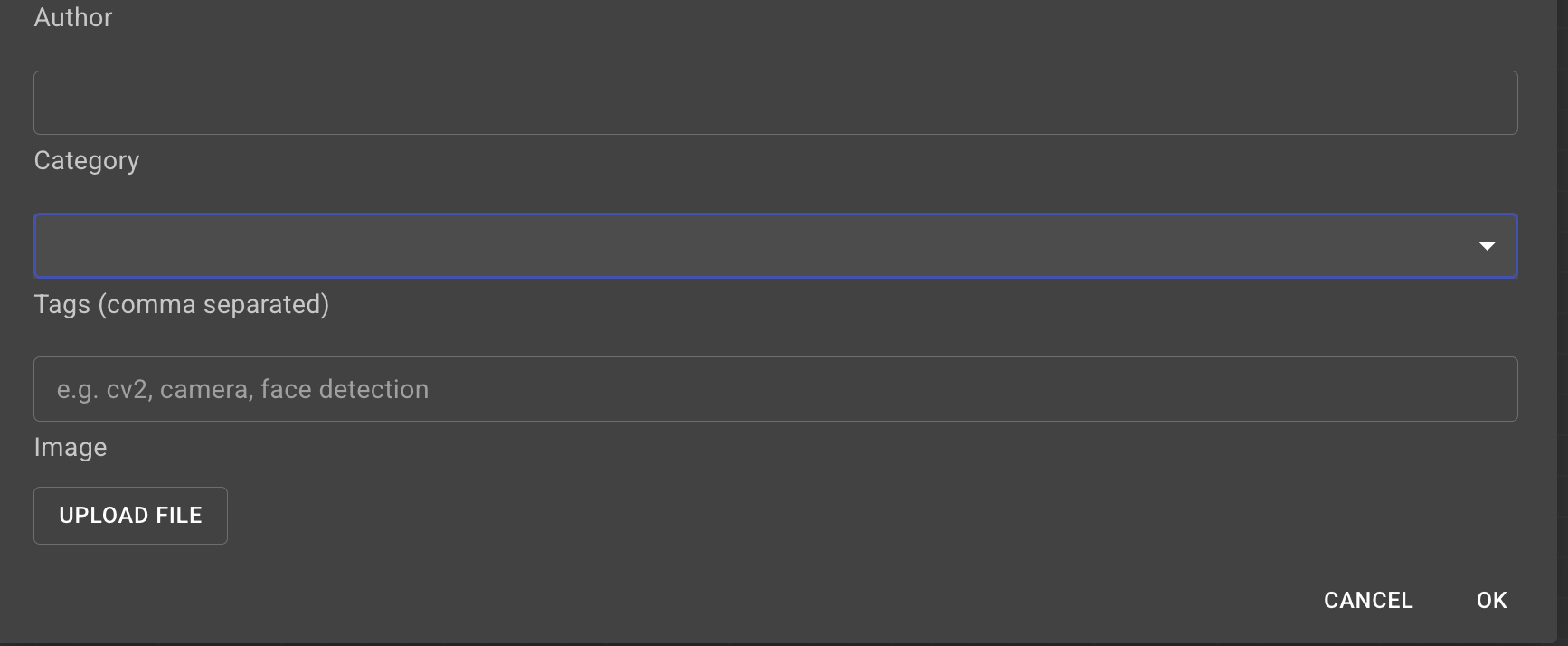
Before blocks could be displayed in a categorized marketplace, they needed a way to identify themselves. I updated the core .vc3 save system and the “Project Info” dialog UI in the frontend. Users can now assign a Category (e.g., Computer Vision, Locomotion) and custom Tags to their blocks. When a user clicks “Save As”, this new metadata is permanently embedded directly into the JSON structure, making it readable by the marketplace backend.
2. Shifting to the Cloud & CI/CD Security
To host the marketplace, I shifted the registry architecture to the VisualCircuit-resources repository to act as our cloud backend. Instead of relying on a static database, I utilized GitHub Actions to create an automated CI/CD pipeline!
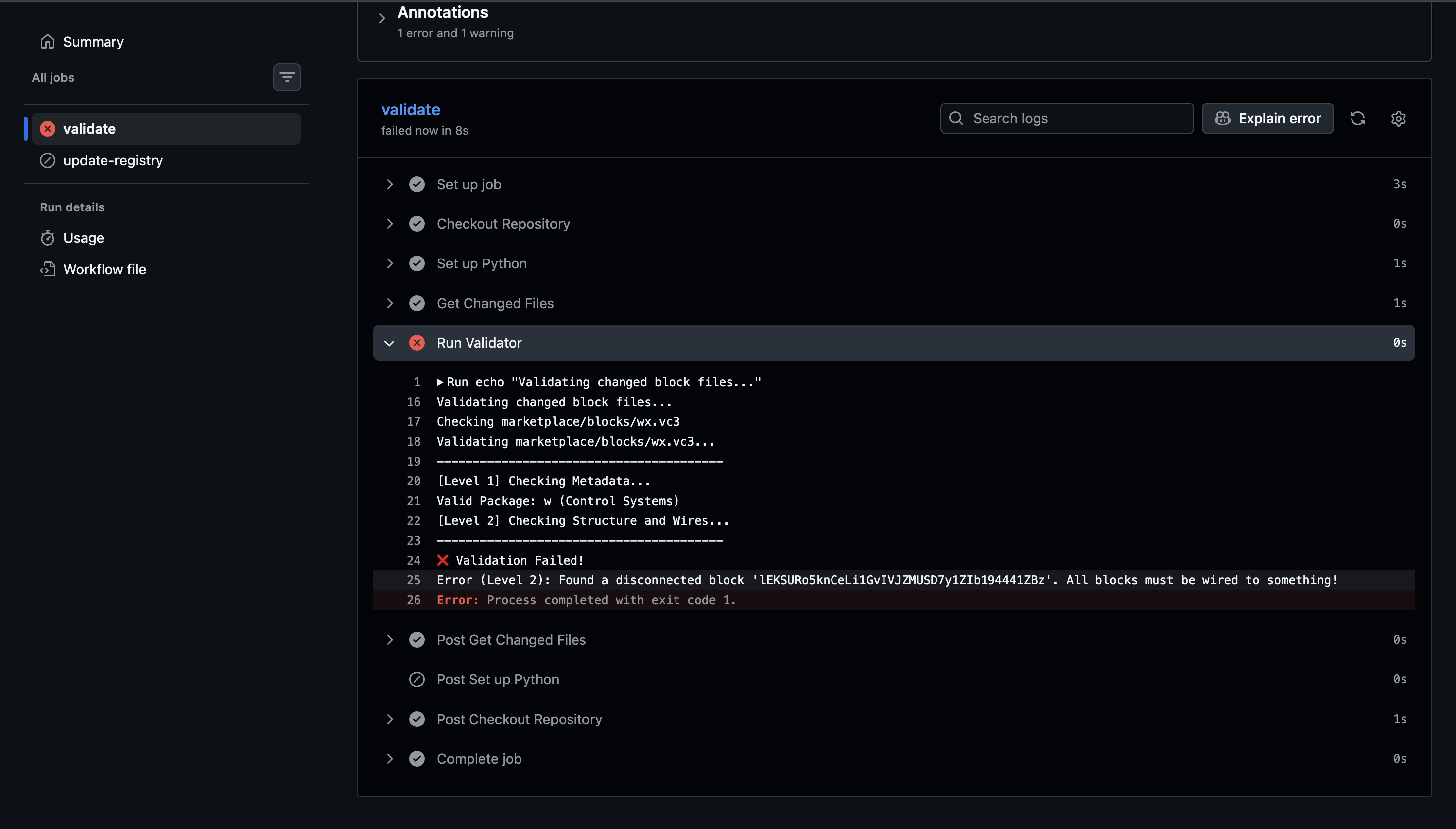
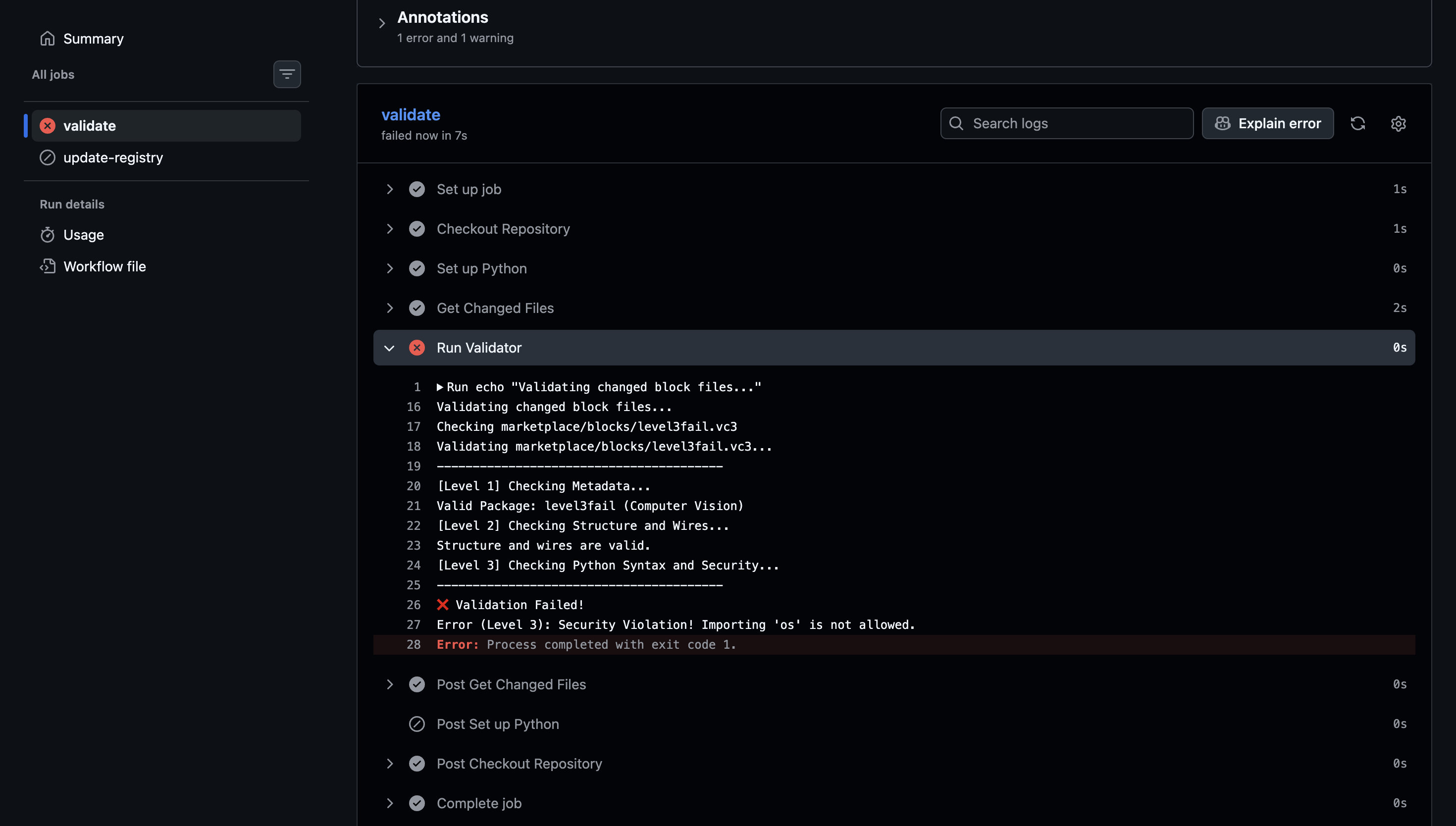
- The 3-Level Validator: I wrote a Python script (
validator.py) that tests any block submitted via a Pull Request. It checks Level 1 (Metadata), Level 2 (Structural Wiring), and Level 3 (A Python Security Firewall that scans for malicious code imports likeosorsubprocess). - Auto-Publishing: Once a Pull Request passes validation and is merged, a GitHub Action automatically triggers
update_registry.py. This script scans theblocks/directory, extracts all metadata, generates a freshregistry.jsondatabase with absolute GitHub Raw download links, and pushes it back to the main branch!
Here is how the validator responds when it catches errors: 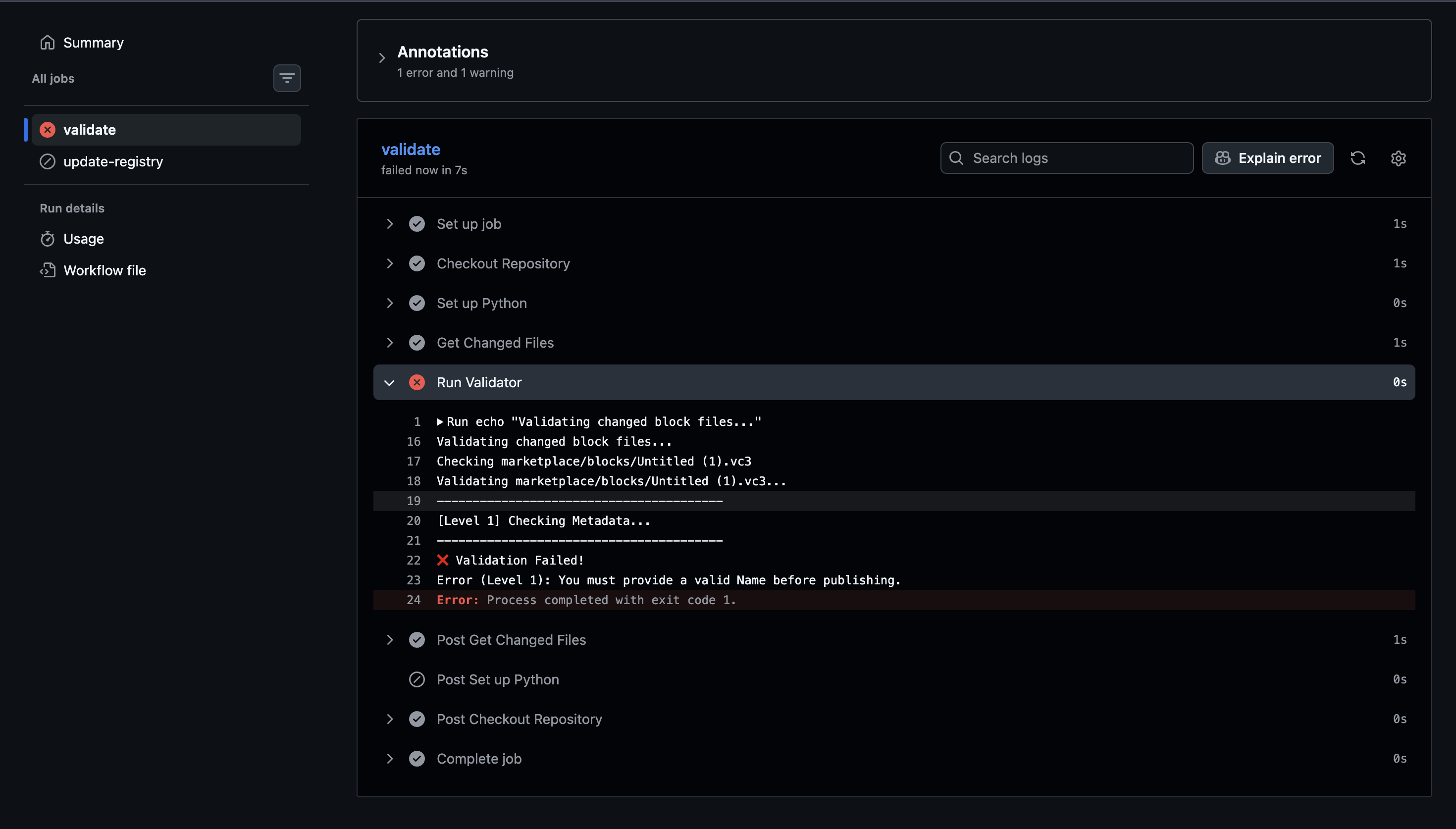
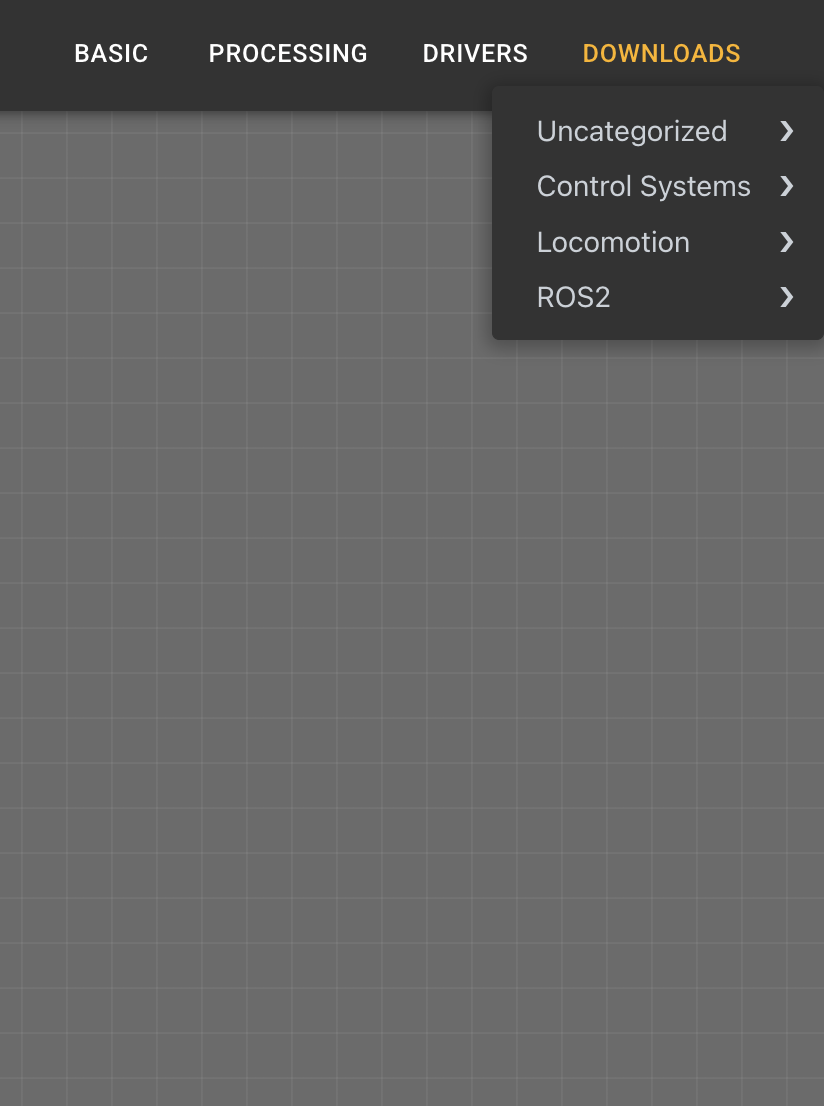
3. Frontend UI, Downloads, and Palette Injection
With the cloud registry generating live data, I built the Marketplace UI panel in the React frontend to fetch the registry.json directly from GitHub. I then engineered the installation process:
- Clicking “Install” triggers a fetch request to GitHub’s raw servers to download the
.vc3file. - The block data is immediately saved into the browser’s persistent
localStorage. - It is dynamically injected into the left sidebar palette. Depending on its metadata, it is perfectly grouped under the correct Category header alongside the native blocks!
The Challenges and Difficulties
Building a system that spans across multiple repositories and relies heavily on both React and GitHub Actions came with several tough technical hurdles:
- Injecting Blocks into the Native Palette: One of the hardest frontend challenges was dynamically injecting downloaded blocks into the existing visual sidebar palette. I had to carefully intercept the React component that renders the native blocks, read from
localStorage, and inject the new blocks on the fly while ensuring they were categorized seamlessly alongside the built-in elements. - Refining the Python Validator: Making the Python validator intelligent was much harder than anticipated. Originally, my validator strictly required every block to contain a
basic.codenode. However, I realized this broke VisualCircuit’s ability to create “Macro Blocks” (where a user simply wires two native blocks together, like a Camera to a Drive, without writing custom code). I had to rewrite the structural wiring checks to dynamically ensure that every block placed on the canvas was wired to something, regardless of what type of node it was. - Splitting and Stacking Pull Requests: Because these features were so deeply intertwined (the Downloads panel relies on the Marketplace, and the Marketplace relies on the Tags), preparing the code for review was difficult. I had to learn how to expertly use Git to “stack” my branches. I separated the code into three distinct PRs (
feature/tags-improvement,feature/marketplace, andfeature/downloads-palette), setting the base of each PR to the previous branch. This allowed my mentors to review the code in clean, bite-sized pieces without any merge conflicts!
This week successfully bridged the gap between local block creation and global community sharing. All the end-to-end testing has passed, the PRs are submitted, and I’m looking forward to refining the UI next week!
🤝 Mentor Meeting
Pull Requests
Here are the Pull Requests submitted for this week’s features: