Internship Progress Week 4
What I did this week
This week I finished setting up Nav2 as the expert navigation system in the local ROS 2 environment.
I configured the autonomous_car in holonomic mode and used:
- NavFn as the global planner,
- DWB as the local controller,
- and the LiDAR data converted to LaserScan for obstacle detection.
I also tuned the local costmap parameters to improve obstacle avoidance and reduce collisions during navigation.
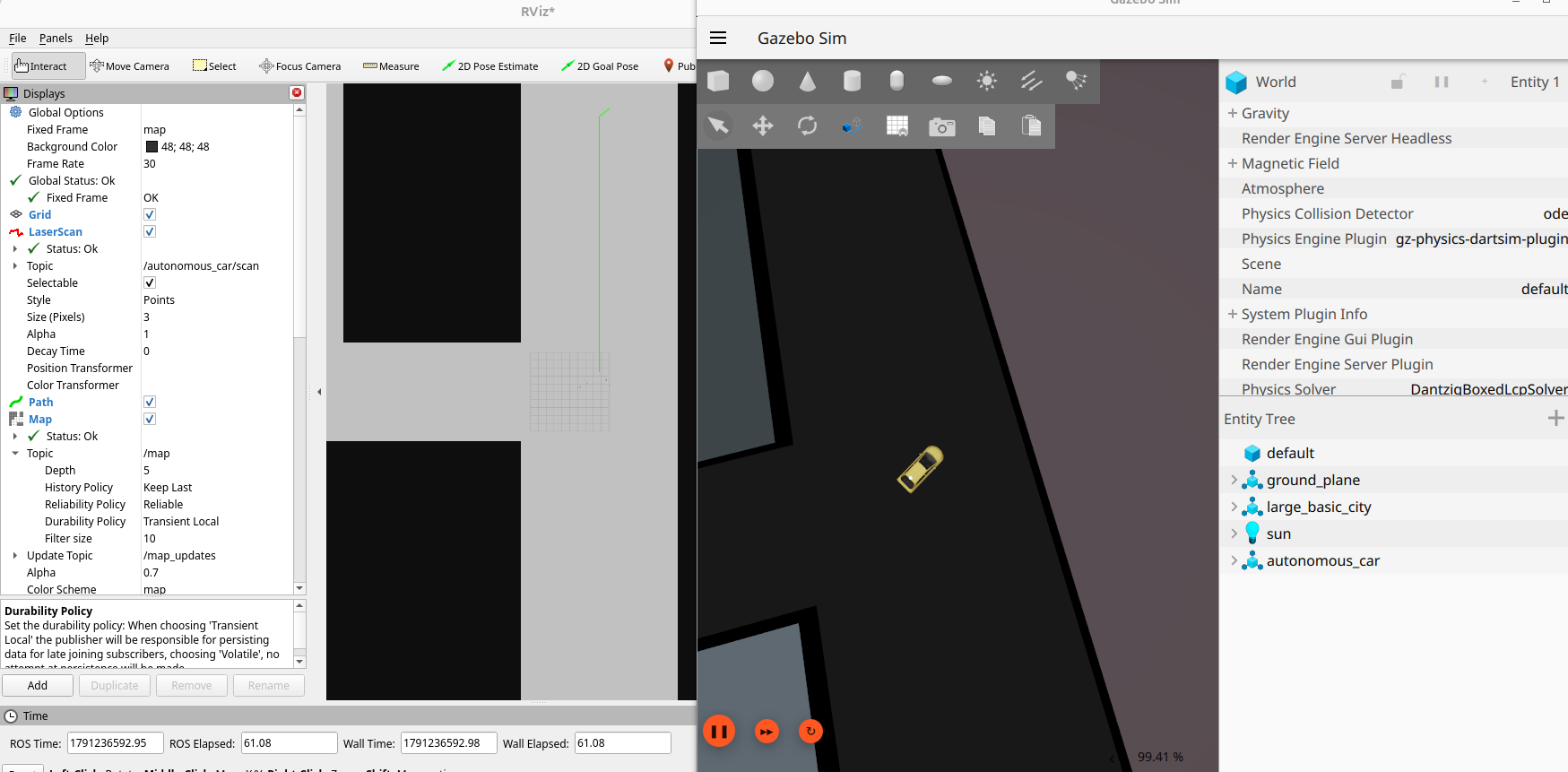
After validating the expert navigation, I recorded the first demonstration using ros2 bag, including:
1
2
3
4
5
6
7
/plan
/autonomous_car/scan
/autonomous_car/odom
/autonomous_car/cmd_vel
/tf
/tf_static
/clock
The recorded demonstration was then processed offline to generate the first supervised dataset.
The preprocessing pipeline includes:
1
2
3
4
5
6
7
8
9
10
11
12
13
rosbag
   ↓
global plan processing
   ↓
LiDAR processing
   ↓
odometry processing
   ↓
temporal synchronization
   ↓
future trajectory generation
   ↓
dataset
For each sample, the current input is:
1
2
3
Global plan: 10 × (x, y)
LiDAR: 360 ranges
Odometry: (v, w)
and the output is a future trajectory with 5 poses:
1
2
3
4
5
t+1s
t+2s
t+3s
t+4s
t+5s
with each pose represented as:
1
(x, y, cos(yaw), sin(yaw))
From the first recorded trajectory, I generated 169 supervised samples.
Navigation demo
Next steps
The next step is to validate several dataset samples visually and then record many more expert trajectories.
After that, I will start reproducing the neural network architecture from the Stanford paper and train the first Imitation Learning model.