
Coding Week 2 — Ghost Layer Killed, PyTorch Evicted
Week 1 removed the caches. Week 2 went after the two biggest single sources of bloat in the entire image: the 4.6 GB copy-on-write ghost layer produced by the RoboticsInfrastructure clone, and the 4.79 GB PyTorch layer that was sitting in the image without being the right tool for the job. Both are gone. The new baseline is 19.2 GB, down from 26.4 GB — a 7.2 GB reduction in a single week.
First Half — The 4.6 GB Ghost Layer
The community bonding audit had already identified the root cause of this one. In Dockerfile.humble, the RoboticsInfrastructure repository was cloned in one RUN instruction (producing a 4.61 GB layer), packages were relocated with mv in a second instruction (2.91 GB layer), and the .git directory was deleted in a third. Because each RUN produces an independent overlay layer in Docker’s copy-on-write filesystem, all three states were baked permanently into the image history. The full clone — .git pack files and all — never left the image regardless of what the later steps did.
The fix was to collapse all three steps into a single atomic RUN block so Docker only records the final state:
# Before — three separate layers, ghost data accumulates permanently
RUN git clone --depth 1 https://github.com/JdeRobot/RoboticsInfrastructure.git /tmp/RI
RUN mv /tmp/RI/Launchers /opt/jderobot/ && \
    mv /tmp/RI/Universes /opt/jderobot/ && \
    mv /tmp/RI/Worlds /opt/jderobot/
RUN rm -rf /tmp/RI

# After — single layer, only the final filesystem state is recorded
RUN git clone --depth 1 https://github.com/JdeRobot/RoboticsInfrastructure.git /tmp/RI && \
    mv /tmp/RI/Launchers /opt/jderobot/ && \
    mv /tmp/RI/Universes /opt/jderobot/ && \
    mv /tmp/RI/Worlds /opt/jderobot/ && \
    rm -rf /tmp/RI
One constraint that had to be respected: /opt/jderobot/Launchers, /Universes, and /Worlds are hardcoded paths in both the PostgreSQL database and the Django backend. Moving them to a different destination would have broken exercise routing silently. The structure was preserved exactly. The .git history was also stripped from every other git clone in the same file — aerostack2, IndustrialRobots, gz_ros2_control — using the same single-RUN pattern, since none of them need their git history at runtime.
The result: 26.4 GB → 21.8 GB, and dive confirmed 96% image efficiency with the infrastructure duplication fully removed.
| Metric | Before | After |
|---|---|---|
| Full image size | 26.4 GB | 21.8 GB |
| Ghost layer eliminated | — | −4.6 GB |
dive efficiency score |
— | 96% |
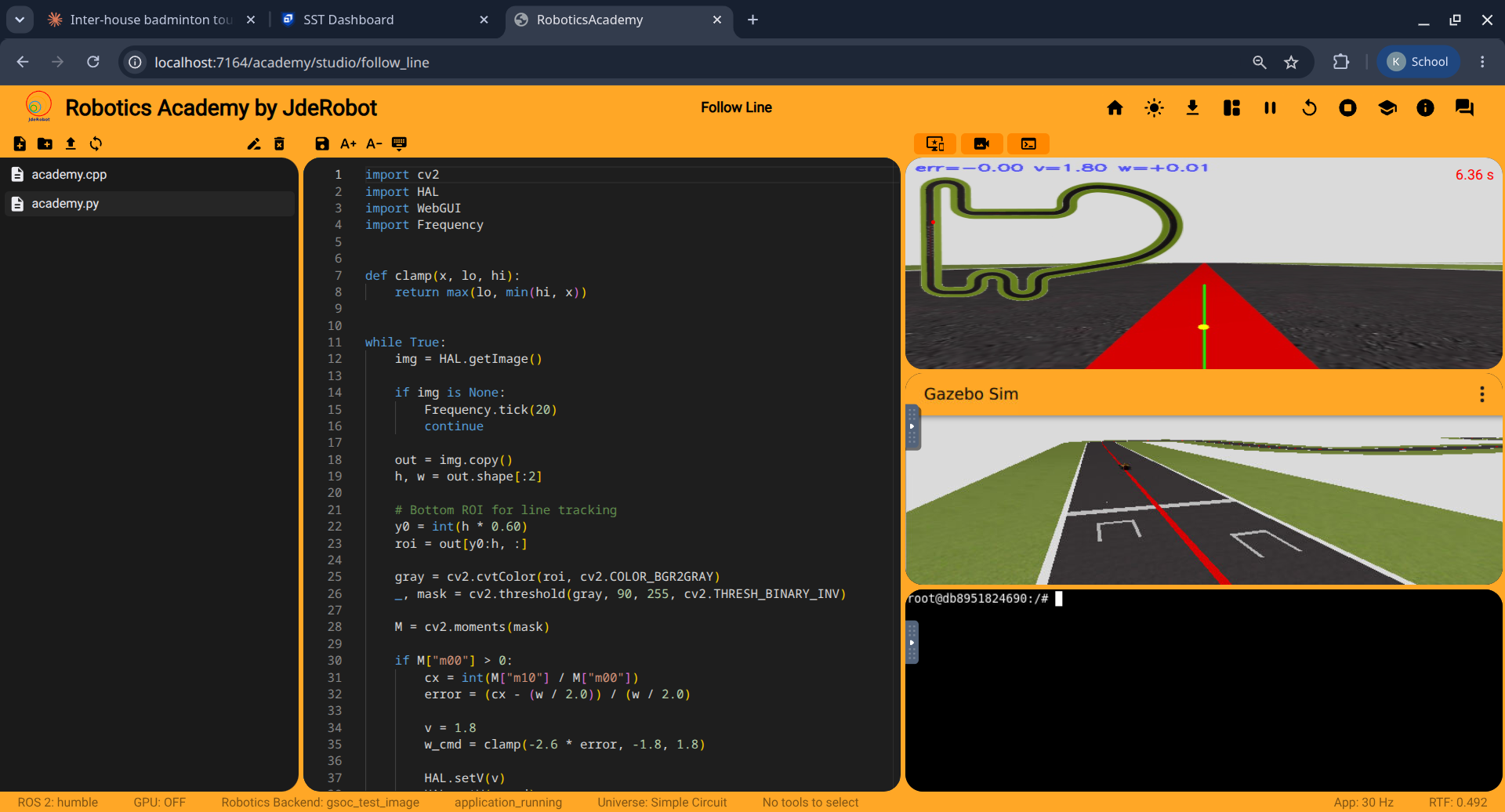
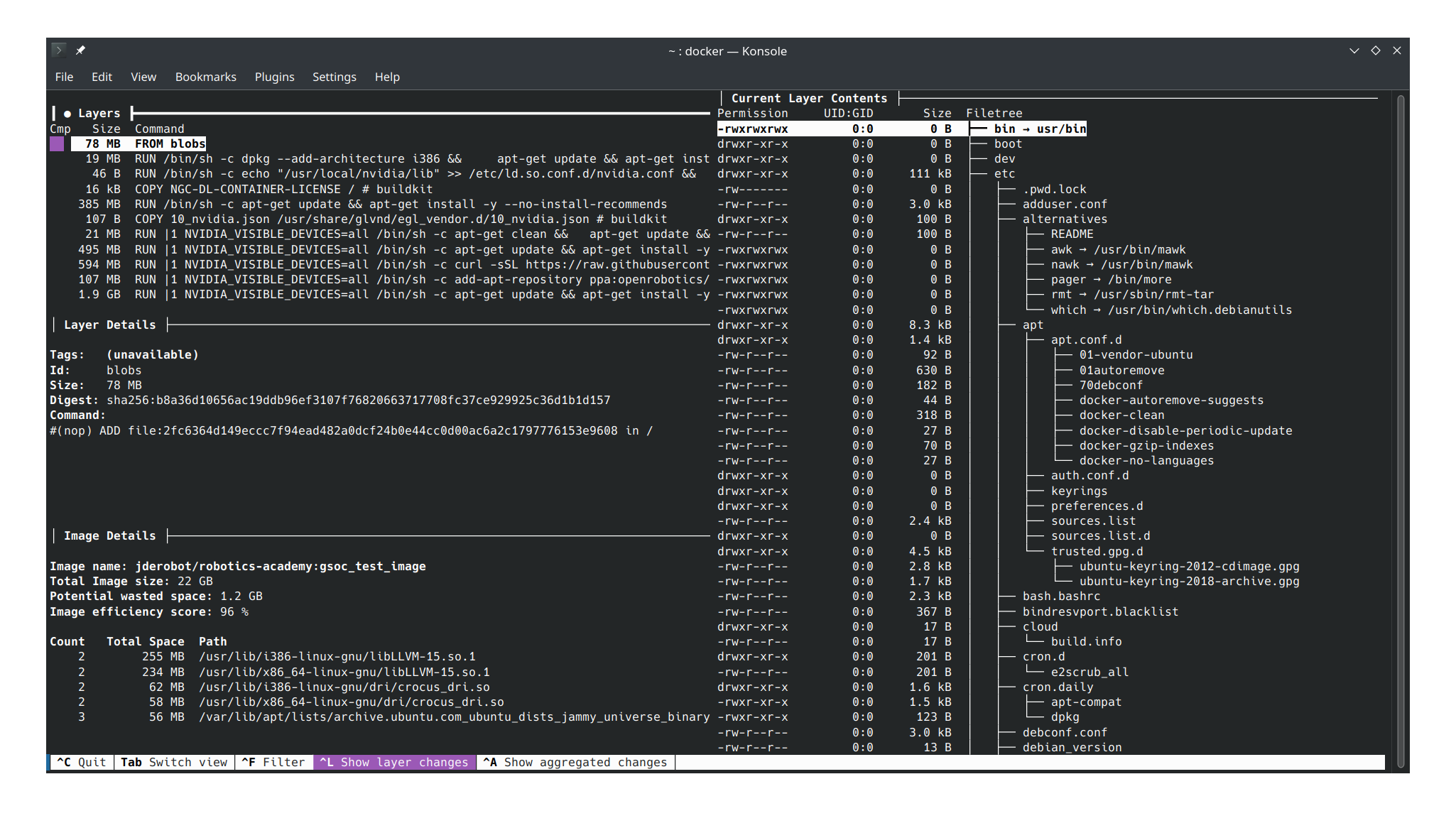
PR #3856 tracks this change.
Second Half — Evicting PyTorch
With the image at 21.8 GB, the next target was the largest remaining layer: the 4.79 GB PyTorch install that sat in Dockerfile.dependencies_humble. PyTorch was originally included to provide GPU-accelerated tensor operations for the deep learning exercises. But the platform does not do PyTorch training — it does inference. And inference at this scale is exactly what ONNX Runtime is built for.
Javier had flagged in the Week 1 sync that an earlier attempt to swap PyTorch for ONNX Runtime had failed. That attempt had hit a GPU provider loading issue — onnxruntime-gpu could find the CUDA libraries at build time but lost them at runtime when ROS 2 workspace sourcing (setup.bash) overwrote the environment. The root cause was relying on LD_LIBRARY_PATH to expose the CUDA shared objects. ROS 2 replaces that variable when you source a workspace, and the GPU provider silently fell back to CPU.
The second attempt fixed the architecture of the dependency wiring rather than just the packages.
The Architecture: What Changed
The old stack pulled in PyTorch’s bundled CUDA as a side effect of a single pip install. The new stack is explicit: only the 5 CUDA pip wheels that onnxruntime-gpu actually needs at runtime are installed, and their shared library paths are written permanently into the system linker cache using /etc/ld.so.conf.d/ rather than being set in an environment variable.
graph TD
    subgraph OLD["Old Stack"]
        PT["pip install torch<br/>4.79 GB<br/>CUDA bundled implicitly"]
        PT --> ORT_old["onnxruntime-gpu 1.22.0"]
        PT --> LDP["LD_LIBRARY_PATH<br/>volatile — reset by<br/>source setup.bash"]
        LDP -. silently drops GPU provider .-> CPU["Falls back to CPU"]
    end

    subgraph NEW["New Stack"]
        W1["cuda-runtime-cu12"]
        W2["cublas-cu12"]
        W3["cudnn-cu12"]
        W4["nvjitlink-cu12"]
        W5["nvrtc-cu12"]
        W1 & W2 & W3 & W4 & W5 --> LD["/etc/ld.so.conf.d/cuda.conf<br/>ldconfig — permanent,<br/>ROS2-immune"]
        LD --> ORT_new["onnxruntime-gpu 1.22.0"]
        ORT_new --> PROV["CUDAExecutionProvider<br/>TensorrtExecutionProvider"]
    end
The ldconfig approach bakes the NVIDIA library paths directly into the system’s dynamic linker cache. It runs once at build time and does not depend on any shell variable. Sourcing any number of ROS 2 workspaces has no effect on it. numpy and onnx were also added explicitly to the foundational layer — they had been arriving transitively through PyTorch, and without pinning them directly they would have been silently stripped.
The dev-test-compose.yaml orchestration file also needed a patch: the GPU resource reservation block had not been declared, so the host NVIDIA drivers were not being mapped into the container at runtime. Added the explicit driver: nvidia reservation to fix that.
deploy:
  resources:
    reservations:
      devices:
        - driver: nvidia
          count: all
          capabilities: [gpu]
Testing — Four Layers
Shipping a GPU change without layered verification is how silent regressions happen, so the gsoc_test_image_v6 build was put through four explicit checks before being called done.
Layer 1 — Hardware mapping. Running nvidia-smi through the compose stack confirmed the host GeForce GTX 1650 was visible inside the container with no fallback warnings.
Layer 2 — System linker and provider availability. ldconfig -p explicitly listed all 5 required .so files pointing to their pip dist-packages locations. An isolated Python shell confirmed onnxruntime.get_available_providers() returned ['TensorrtExecutionProvider', 'CUDAExecutionProvider', 'CPUExecutionProvider'] in that order.
Layer 3 — UI and integration validation. The full stack was booted via the patched compose profile. The frontend workspace registry rendered correctly, and the vision-heavy exercises loaded their Gazebo worlds and noVNC video streams without any runtime exception or tracking regression.
Layer 4 — End-to-end inference. A minimal ONNX identity model (IR Version 8, Opset 13) was generated and executed directly on the GPU inside the container. The execution output:
Active provider: CUDAExecutionProvider
PASS: GPU inference completed successfully
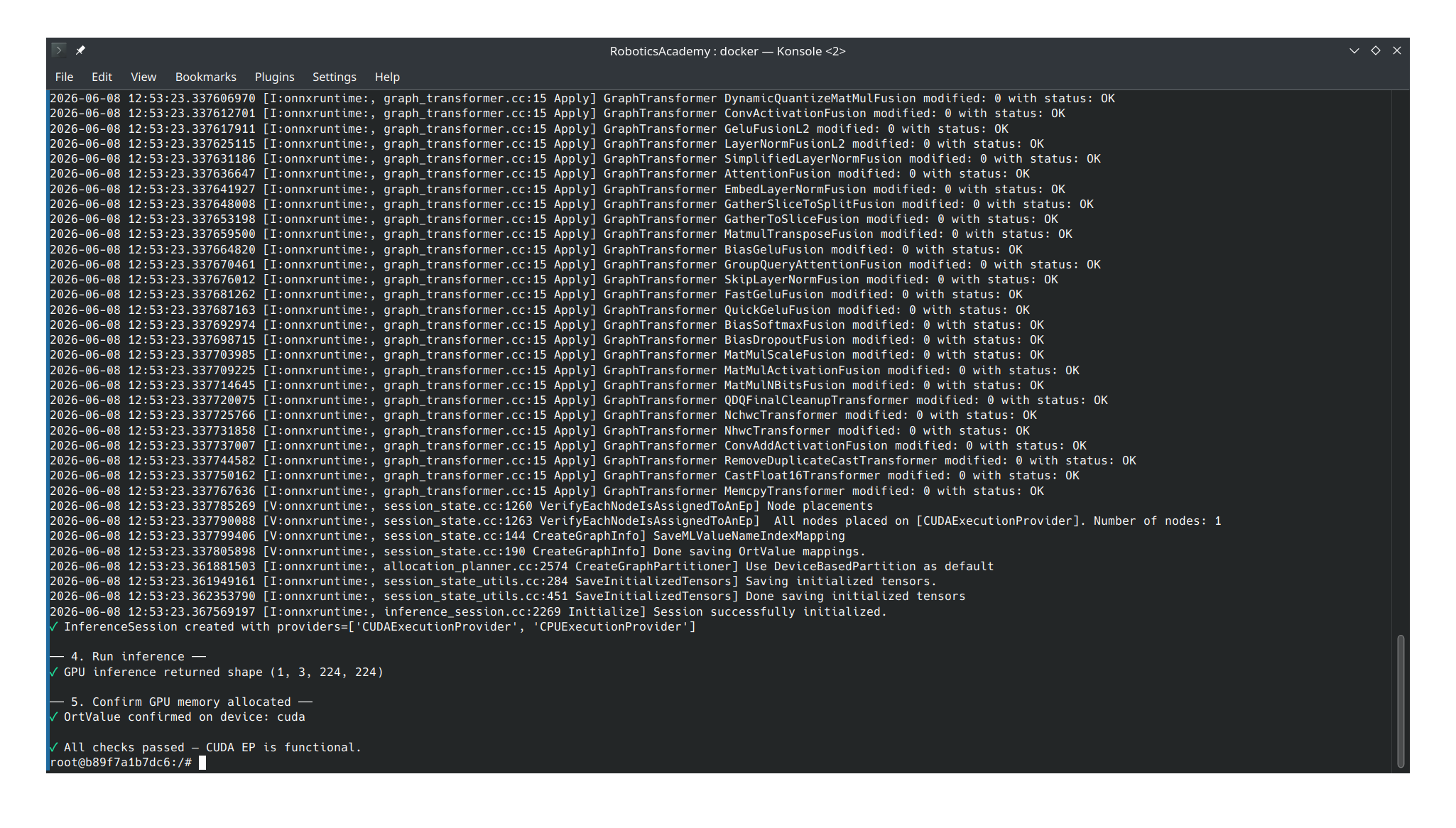
All four layers passed on gsoc_test_image_v6 (Image ID: fcd9373d4326).
Week 2 Final Numbers
| Metric | Start of Week | After Ghost Layer | After PyTorch Removal | Total Change |
|---|---|---|---|---|
| Image size | 26.4 GB | 21.8 GB | 19.2 GB | −7.2 GB |
| PyTorch layer | 4.79 GB | 4.79 GB | 0 | −4.79 GB |
| GPU inference | working | working | working via CUDA wheels | no regression |
| ROS2 env immunity | no | no | yes (ldconfig) | new property |
What is Next
The 19.2 GB number is the new baseline. Three items remain before the dependency changes are fully closed.
The CUDA wheel versions — nvidia-curand-cu12 and nvidia-cufft-cu12 — are not yet pinned in the Dockerfile. They need hard pins to prevent silent ABI drift on future CI builds.
The C++ ONNX Runtime headers in the image are at version 1.17.1 while the Python runtime is at 1.22.0. That gap is a latent issue for any exercise that calls into the C++ API and needs to be aligned.
A full exercise test run is still needed on the patched Dockerfile.dependencies_humble to confirm no regressions before the PR can merge.
Next week: pin the remaining CUDA wheel versions, complete exercise testing on Dockerfile.dependencies_humble, and begin the multi-stage build split.
Part of my GSoC 2026 work with JdeRobot. Project tracked at github.com/TheRoboticsClub/gsoc2026-Kartik_Jangid.