
Coding Week 7 — Dependency Fixes, First Podman Build
Half-week post — mentor review reopened two things in the split, and the rest went into a first Podman build test.
Dependency Fixes from Mentor Review
Mentor review on the split: 11.9GB to 10.7GB didn’t justify the added complexity, and clean build time roughly doubled — 20 to 40 minutes — since deps-final keeps the full ROS toolchain, paying colcon’s cost twice. Also flagged: the narrow /usr/local COPY from the size-regression fix had silently broken OMPL’s Python bindings and pg_dump.
OMPL’s bindings install via install-ompl-ubuntu.sh --python into /usr/lib/python3/dist-packages/ompl/, not /usr/local, so that COPY missed them — fixed with one more explicit COPY at Dockerfile.dependencies_humble:598.
pg_dump was missing outright: deps-final only had libpq5, and the admin section’s save_exercise_db/save_universe_db views call it directly. Added postgresql-client-18 at line 463, pinned because the database container runs Postgres 18 and pg_dump won’t dump a newer server than itself.
That surfaced a second bug: deps-final had PGDG’s source copied in before ca-certificates existed, so the HTTPS fetch to apt.postgresql.org failed. Fixed with a ca-certificates-only install at line 414, ahead of the PGDG COPY, matching deps-builder’s order.
Verified both directly: imported OMPL’s bindings, ran pg_dump against a live Postgres 18 container. Net size: 9.55GB, up slightly from 9.49GB before these fixes.
First Podman Build
Set up a podman-compat-test branch off humble-devel with the original Dockerfiles, kept separate from the refactor so results don’t mix. First failure: Dockerfile.dependencies_humble’s FROM line — nvidia/opengl:1.2-glvnd-runtime-ubuntu22.04 is an unqualified image name, and Podman won’t assume Docker Hub for those the way Docker does.
There were two ways to fix this. One was fully qualifying the reference in the Dockerfile itself, docker.io/nvidia/opengl:1.2-glvnd-runtime-ubuntu22.04 — no config changes, but it means editing the file, and the point of this branch was testing the original Dockerfiles unmodified. The other was configuring a default search registry on the Podman side, which doesn’t touch the Dockerfile at all: adding unqualified-search-registries = ["docker.io"] to ~/.config/containers/registries.conf. Rootless Podman reads that file before the system-wide /etc/containers/registries.conf, so it doesn’t need sudo either. I went with the registry config for this test, since keeping the Dockerfile untouched was the whole point. Worth noting for later, though, fully qualifying the image reference is probably the better fix for the actual codebase, since it means anyone building this under Podman doesn’t need to know about registry config at all. That’s a small, separate change I’d want to raise once this testing phase moves further.
After that, both Dockerfiles built clean under Podman unmodified — 26 workspace packages compiled. Running it standalone, GPU detection found nothing and fell back to CPU-only without crashing (no GPU needed for this pass), and Django plus the RAM manager’s websocket server both started. The only error was Django failing to reach a nonexistent database host — expected in a standalone run, same as plain Docker with no DB present.
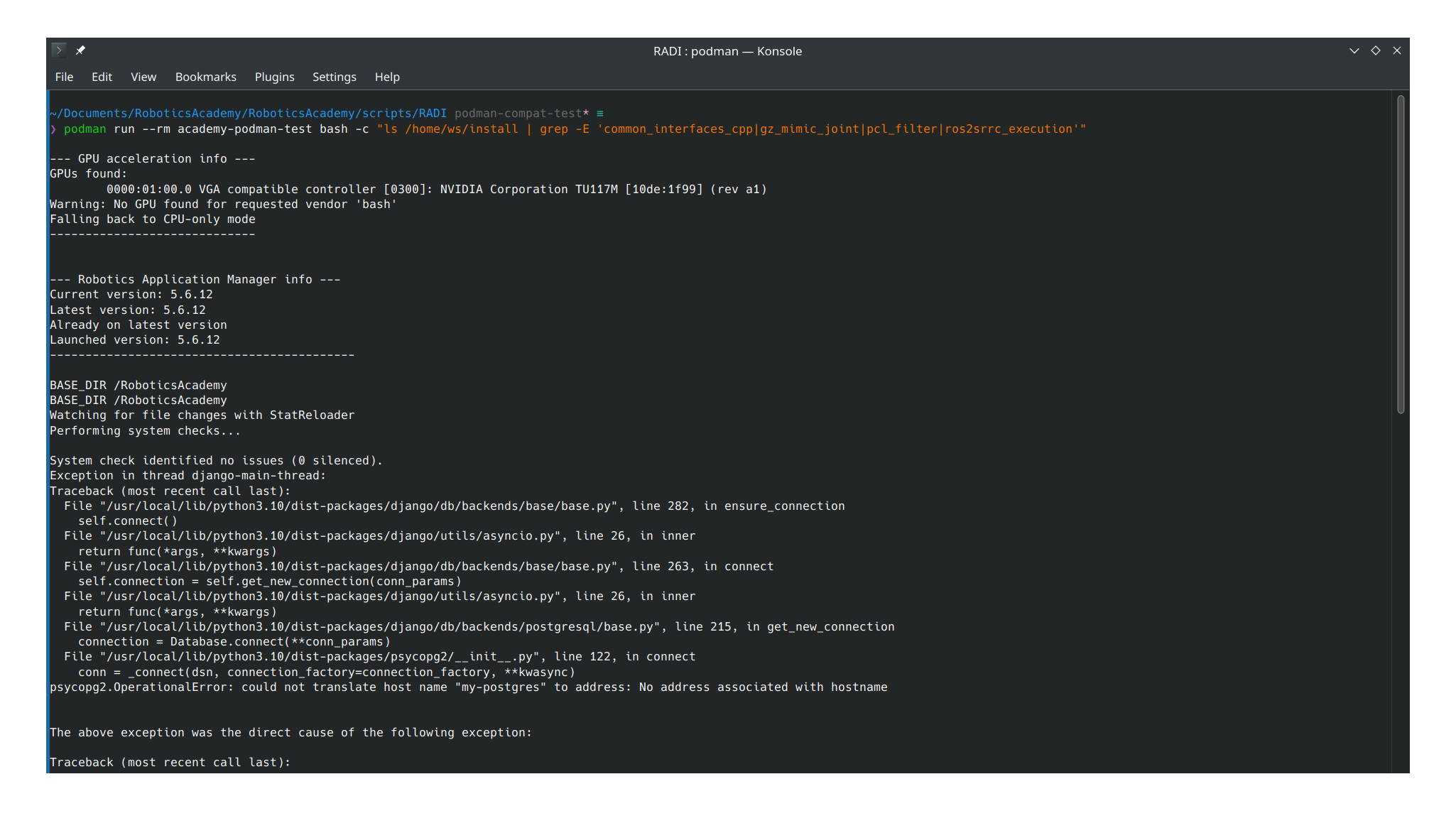
Next is the full compose stack under Podman. The compose file requests GPU reservations Podman can’t interpret, so I’m preparing a GPU-free variant — then the goal is launching one exercise inside RA to confirm end-to-end compatibility.
Part of my GSoC 2026 work with JdeRobot. Project tracked at github.com/TheRoboticsClub/gsoc2026-Kartik_Jangid.